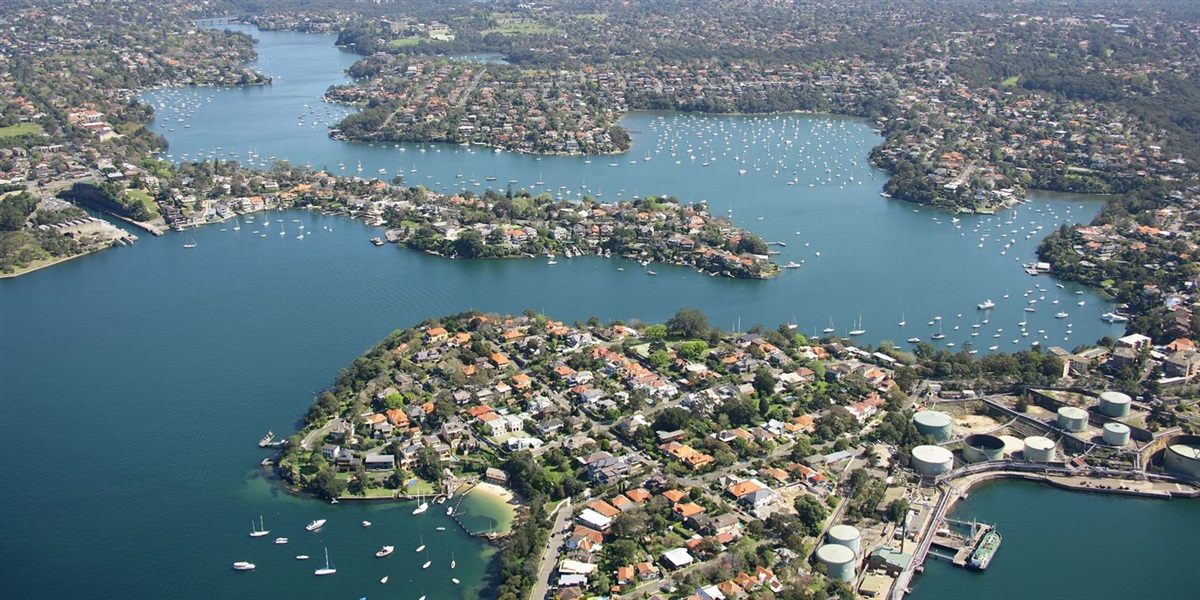
The City of Ryde is a local government area in the Northern Sydney region, in New South Wales, Australia. It was first established as the Municipal District of Ryde in 1870, became a municipality in 1906 and was proclaimed as the City of Ryde in 1992.
The local government area extends from the Parramatta River to the Lane Cove River which encircles the area in the north, and is bounded in the east by the peninsula of Hunters Hill and the City of Parramatta in the west. The City comprises an area of 40.651 square kilometres (15.695 sq mi) and as at the 2021 census had an estimated population of 129,123.
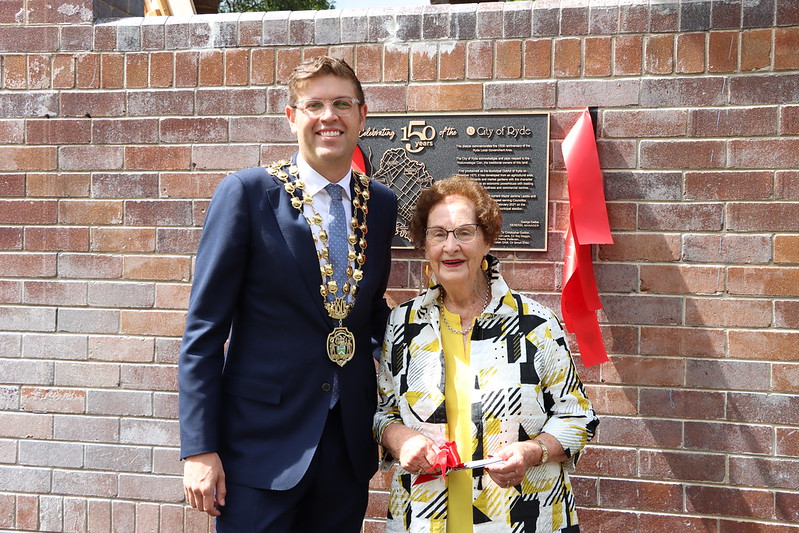
The mayor of the City of Ryde since 28 March 2024 is Councillor Trenton Brown, a member of the Liberal Party.
Suburbs and localities in the local government area
The following suburbs and localities are within the City of Ryde:
Heritage listings
The City of Ryde has a number of heritage-listed sites, including:
- Denistone, 1-13 Pennant Avenue: The Hermitage
- Eastwood, Marsden Road: Brush Farm
- Gladesville, 144 Ryde Road: Gladesville Drill Hall
- Ryde, 782 Victoria Road: Willandra, Ryde
- Ryde, 808-810 Victoria Road: Ryde police station
- Ryde, 813 Victoria Road: Addington House
- Ryde, 817 Victoria Road: The Retreat, Ryde
- West Ryde, 135 Marsden Road: Riverview House, West Ryde
- West Ryde, Victoria Road: Ryde Pumping Station
Demographics
At the 2021 census, there were 129,123 people in the Ryde local government area, of these 48.8% identified as male and 51.2% identified as female. Aboriginal and Torres Strait Islander people made up 0.5% of the population. The median age of people in the City of Ryde was 37 years. Children aged 0 – 14 years made up 16.2% of the population and people aged 65 years and over made up 14.3% of the population. Of people in the area aged 15 years and over, 51% were married and 8.3% were either divorced or separated.
Population growth in the City of Ryde between the 2006 Census and the 2011 Census was 6.28%, and in the subsequent five years to the 2016 Census, population growth was 12.87%. When compared with total population growth of Australia of 8.81% during the same period, population growth in the Ryde local government area was approximately 50% higher than the national average. The median weekly income for residents within the City of Ryde was around 25% above the national average. At the 2021 Census, the Ryde local government area was linguistically diverse, with a significantly higher than average proportion (55.3%) where two or more languages are spoken (the national average was 24.8%); and a significantly lower proportion (46.3%) where English only was spoken at home (national average was 72.0%).
Council
Current composition and election method
The City of Ryde is composed of twelve councillors elected proportionally as three separate wards, each electing four councillors. All councillors are elected for a fixed four-year term of office. The mayor since 2024 is directly elected for a four-year term. The most recent election was held on 14 September 2024. The makeup of the council is as follows:
The current Council, elected in 2024 is:
Referendum on the position of mayor
A referendum was also undertaken at the election held on 4 December 2021, asking residents the following question: "Do you support a popularly elected Mayor where the voters of the City of Ryde elect the Mayor for a four (4) year term, thereby adopting a thirteen (13) Councillor model (including the Mayor)?". The final declared results were: 76.18% YES and 23.82% NO. As a result, the position of mayor was directly elected from the next local government elections scheduled for 2024.
Election results
2024
Council history
In June 1870, 201 residents of the district of Ryde sent a petition to the governor, requesting the incorporation of the "Municipal District of Ryde". This resulted in the municipality being formally proclaimed on 11 November 1870. With a total land area of 40.6 square kilometres, Ryde was the largest Sydney municipality. However, due to an error in the proclamation regarding the western boundary, a new proclamation was made on 11 June 1872.
In June 1894 the northern section of the municipality known as Marsfield, was proclaimed as the "Municipal District of Marsfield". In 1907, Marsfield became known as the Municipality of Eastwood, and lasted until it was re-amalgamated with Ryde following the passing of the Local Government (Areas) Act 1948.
With the passing of the Local Government Act 1906, the council name was changed to be the "Municipality of Ryde". The City of Ryde was proclaimed by the Governor, Peter Sinclair, on 20 September 1991, and with the passing of the Local Government Act 1993, aldermen were also retitled councillors and the town clerk became the general manager.
A 2015 review of local government boundaries by the NSW Government Independent Pricing and Regulatory Tribunal recommended that the City of Ryde merge with adjoining councils. The government proposed a merger of the Hunter's Hill, Lane Cove and Ryde Councils to form a new council with an area of 57 square kilometres (22 sq mi) and support a population of approximately 164,000. In July 2017, the Berejiklian government decided to abandon the forced merger of the Hunter's Hill, Lane Cove and Ryde local government areas, along with several other proposed forced mergers.
Town Clerks and General Managers
International relations
- Stepanakert, Republic of Artsakh: The City of Ryde established a Friendship Declaration with Stepanakert, the capital of the partially-recognised Republic of Artsakh on 23 July 2019.
- Ryde, Isle of Wight
Coat of arms
Notes
References
External links
- City of Ryde website