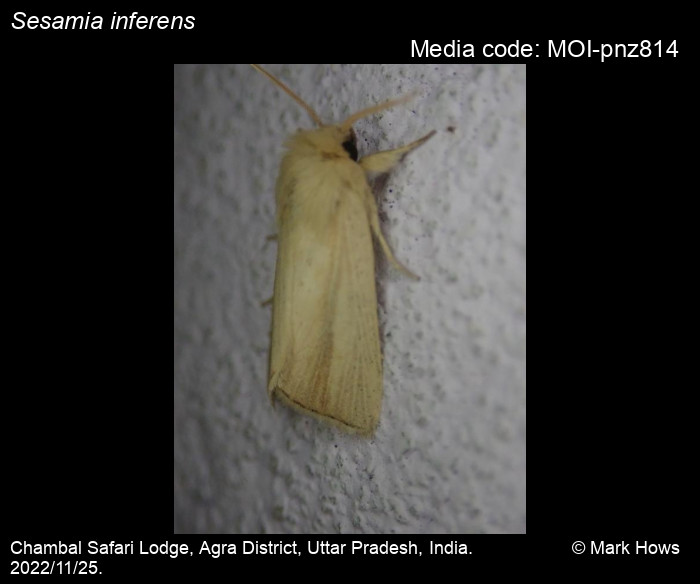
Sesamia inferens, the Asiatic pink stem borer, gramineous stem borer, pink borer, pink rice borer, pink rice stem borer, pink stem borer, purple borer, purple stem borer or purplish stem borer, is a moth of the family Noctuidae. The species was first described by Francis Walker in 1856. It is found from Pakistan, India, Sri Lanka, Myanmar to Japan and the Solomon Islands. A polyphagous species, it is a major pest in many crops worldwide.
Description
Its wingspan is about 28 mm. Hindwings with veins 3 and 4 from arise from the cell. Antennae of male ciliated and simple in female. Body ochreous. Forewings with a red-brown suffusion along median nervure and veins 2 to 5. A sub-marginal dark line present. Cilia paler. Hindwings are whitish.
Larva smooth and shiny and lack obvious hairs or markings. Color variable but usually cream white with a distinctive pink suffusion. The head and prothoracic shield are brown. The dorsal part of the last abdominal segment bearing the anus is yellowish brown. Mature larvae are between 30–40 mm long, pink with buff and pink dorsal markings and a brown head. Pupae are up to about 18 mm long, brown to yellowish-brown with a wrinkled frontal region of the head and cremaster with four large and two small spines.
Ecology
The larvae mostly feed on Gramineae species, including Coix, Echinochloa, Oryza, Panicum, Saccharum, Setaria, Triticum, Zea and Zizania. Many of the food plants are of economic importance.
Symptoms
The caterpillars mainly bore into rice stems or the base of the panicle. After infection, the stem becomes wilted causing deadheart. Panicle attack leads to panicle to be cut leading to state called whitehead. Symptoms are mostly similar to other stem borers and hence closer look required to control the attack.
Control
Mechanical controlling using hand picking and pheromone traps are used. Cultural practices like crop rotation mechanisms, reducing water levels are also used in controlling. Natural enemies such as parasitoides are very effective and nature loving controlling measures. The tachinid fly Sturmiopsis inferens was also once used, but is now not effective due to their low abundance. In chemical control, BHC, DDT, fenthion, fenitrothion, quinalphos, phosphamidon sprays and granules of lindane are used. Eggs can be eliminated by introducing Trichogramma minutum and Telenomeus species. Apanteles flavipes, Bracon chinensis and Sturmiopsis inferens are effective against caterpillars, whereas Xanthopinpla species and Tetrastichus aygari are used in pupal stages.
See also
- Sesamia calamistis, the African pink stem borer
References
External links
- Distribution and Insecticide Resistance of Sesamia inferens
- Singh, Beant; Kular, J. S. (2015). "Notes on the Bionomics of the Pink Stem Borer Sesamia inferens Walker (Lepidoptera: Noctuidae): An Upcoming Pest of Wheat in India" (PDF). Acta Phytopathologica et Entomologica Hungarica. 50 (2): 239–259. doi:10.1556/038.50.2015.2.9.
- Mahesh, P.; Chandran, K.; Srikanth, J.; Nisha, M.; Manjunatha, T. (2013). "Natural Incidence of Sesamia inferens Walker, in Sugarcane Germplasm". Sugar Tech. 15 (4): 384–389. doi:10.1007/s12355-013-0212-2. S2CID 22637703.
- Han, L.; Liu, P.; Wu, K.; Peng, Y.; Wang, F. (2008). "Population dynamics of Sesamia inferens on transgenic rice expressing Cry1Ac and CpTI in southern China". Environmental Entomology. 37 (5): 1361–70. doi:10.1603/0046-225x(2008)37[1361:pdosio]2.0.co;2. PMID 19036217. S2CID 24992081.
- Liu, Z.; Gao, Y.; Luo, J.; Lai, F.; Li, Y.; Fu, Q.; Peng, Y. (2011). "Evaluating the non-rice host plant species of Sesamia inferens (Lepidoptera: Noctuidae) as natural refuges: Resistance management of Bt rice". Environmental Entomology. 40 (3): 749–54. doi:10.1603/EN10264. PMID 22251655. S2CID 8586433.
- Semiochemicals of Sesamia inferens
- Sekhar, Javaji C.; Karjagi, Chikkappa G.; Kumar, Bhupender; Rakshit, Sujay; Soujanya, Lakshmi; Kumar, Pradyumn; Singh, Krishan P.; Dhandapani, Appavoo; Dass, Sain; Kumar, Ramanujam S. (2015). "Genetics of resistance to Sesamia inferensinfestation and its correlation with yield in maize". Plant Breeding. 134 (4): 394–399. doi:10.1111/pbr.12281. S2CID 83700613.
- Gao, Yulin; Hu, Yang; Fu, Qiang; Zhang, Jie; Oppert, Brenda; Lai, Fengxiang; Peng, Yufa; Zhang, Zhitao (2010). "Screen of Bacillus thuringiensis toxins for transgenic rice to control Sesamia inferens and Chilo suppressalis". Journal of Invertebrate Pathology. 105 (1): 11–15. Bibcode:2010JInvP.105...11G. doi:10.1016/j.jip.2010.05.002. PMID 20452358.
- Han, Lanzhi; Han, Chao; Liu, Zewen; Chen, Fajun; Jurat-Fuentes, Juan Luis; Hou, Maolin; Peng, Yufa (2014). "Binding Site Concentration Explains the Differential Susceptibility of Chilo suppressalis and Sesamia inferens to Cry1A-Producing Rice". Applied and Environmental Microbiology. 80 (16): 5134–5140. Bibcode:2014ApEnM..80.5134H. doi:10.1128/AEM.01544-14. PMC 4135770. PMID 24928872.
- Differential preference of maize genotypes to Sesamia inferens
- The Complete Mitochondrial Genome of the Pink Stem Borer, Sesamia inferens, in Comparison with Four Other Noctuid Moths
- Sun, Meng; Tang, Xiao-Tian; Lu, Ming-Xing; Yan, Wei-Fei; Du, Yu-Zhou (2014). "Cold Tolerance Characteristics and Overwintering Strategy of Sesamia Inferens (Lepidoptera: Noctuidae)". The Florida Entomologist. 97 (4): 1544–1553. doi:10.1653/024.097.0429. JSTOR 24364116.
- Growth Stage Preference of Pink Stem Borer Sesamia inferens
- Study the egg laying pattern of Sesamia inferens
- Tang, Xiao-Tian; Xu, Jing; Sun, Meng; Xie, Fang-Fang; Du, Yu-Zhou (2014). "First Microsatellites from Sesamia inferens (Lepidoptera: Noctuidae)". Annals of the Entomological Society of America. 107 (4): 866–871. doi:10.1603/AN13190. S2CID 84444400.